Cut you with what I got, off the top like a barber/
Black History like Malcolm, you George Washington Carver/
Cause for alarm like I traded arms with DARPA/
Multiple arms: Doc Ock v. Peter Parker/
You knew from the start that you ain't want no parts of/
These mystical arts, lyrical darts to the heart son/
The origin of tough, like Chuck Norris' father/
Big bang, small package; snub-nosed revolver/
Orangutang thunderstorm, Gorilla Monsoon/
Wrote this with a pen I found up in Mount Doom/
Hot as friction with the writtens - 'you'll find that it's quite cool'/
I'm dismissing your admissions to lyrically fly schools/
While my curriculum is killing 'em, homicide haikus/
Your pedagogy is sloppy, you best to copy my cues/
Ram3 - hit by a bus, he might bruise/
A gangstas gangsta - like the girl in a gang that fights dudes/
Rogues
Wednesday, March 31, 2010

Friday, March 26, 2010
Avatar and Humanity
One can view the film Avatar by James Cameron as commentary on environmental issues. Such a view only scratches the surface. The environmental issues in real-life are staggering in not only their stupidity, but also in their evolution. The environmental issue is based upon the economic issue which is based upon the fundamentally flawed source of all these symptomatic concerns: the ideal of human progression. It's the empirical history of human society that permeates Avatar, the kind of society that allows Christopher Columbus to 'discover' and destroy the Taino and Arawak nations and be celebrated. The society we live in now is built upon the ideologies of men and women bent on subjugating 'the other'. This is the core of the film for me. In regards to its effect on environmentalism, minimal, since Pandora is nowhere near real. However, it may shine some light on some of the mining situations around the world, but even those have class and race issue at their core.
-- Villainy..
-- Villainy..
Thursday, March 25, 2010
In.Fluence vrs. 3
Flow never the same twice - I alternate live/
Schitzophrenic spitter - I alternate lives/
American Terrorist, when I terrorize/
Sounds like Uptown Saturday Night 1-9-7-9/
That's me, globe traveler grew up latchkey/
Real recognized real, and you looking mechanized/
Like Cycloptic fiber optics in Megatron's eyes/
Gangster Nerd, I cast the die with equivalent sides/
Which means I always win, which means I never die/
Ferris Bueller of rap - I don't slack, I scheme through it/
If getting free was a movie - this was the theme music/
Soundtrack to 'Why not sell Ki's"/
How not to be a Square Enix and roll with LC's/
Watching my Little Brother spit and record an LP/
What's real? What's The Matrix - you tell me/
I just write Psyence Fiction, U-N-K-L-E/
Schitzophrenic spitter - I alternate lives/
American Terrorist, when I terrorize/
Sounds like Uptown Saturday Night 1-9-7-9/
That's me, globe traveler grew up latchkey/
Real recognized real, and you looking mechanized/
Like Cycloptic fiber optics in Megatron's eyes/
Gangster Nerd, I cast the die with equivalent sides/
Which means I always win, which means I never die/
Ferris Bueller of rap - I don't slack, I scheme through it/
If getting free was a movie - this was the theme music/
Soundtrack to 'Why not sell Ki's"/
How not to be a Square Enix and roll with LC's/
Watching my Little Brother spit and record an LP/
What's real? What's The Matrix - you tell me/
I just write Psyence Fiction, U-N-K-L-E/
Life on Screen 100-end

This half of the reading was more challenging as Turkle begins to assess the psycho-social aspects of the generational effects of technology on youth (a mouthful).
There are moments in the book where Turkle has interviewed youth around their interactions with technology. It's the interviews that cue us, as the reader, in to what happens next in the blurring between the actual and the virtual: an organic, inborn understanding of the virtual. I think Turkle coined it by noting:
"The idea of talking to technology begins to seem more natural when the computer presents itself less like a traditional machine and more like a demi-person...The reconfiguration of machines as psychological objects and people as living machines..."
It's this deeply psychological inquiry, born in the minds of younger and younger generations, that move our youth toward less of a blurring and more of an symbiotic blending of the actual and the virtual.
Life on Screen 1-100

Sherry Turkle is in many ways writing an expose on the virtual self, from self analysis. I am very in touch with the issue of being seduced by the virtual world. I have a series of user names, and I am a retired hacker (means I got caught). In regards to the writing, Turkle touches upon the crux of the second self, namely, lure.
As an avid video game player, I can speak first hand to using space exploration in Starfox (for super nintendo) as a means of escaping the project buildings I lived in at the time. That was the first time, then it was focusing my frustrations in school on Soul Edge. I hadn't realized how big an issue the second self was for myself until I noticed my little brother had faithfully inherited the lure, his frustrations voiced through the wanton violence of Grand Theft Auto, his inadequacies in school overcompensated for by his desire to enforce nuclear proliferation and anti-terrorism in Metal Gear Solid.
This is the seduction awaiting each more 'wired' generation, Turkle notes how she is compelled to write using a computer, as if the archaic pen(cil) and paper no longer existed, like they never existed. It's Turkle's ties to the analog past that allow her to express her opinions of how the digital world is changing our society, copy and pasting the 'future' onto the past, and becoming the 'always'. What I take from the early half of this reading is that as time progresses, the fact that we weren't always digital in nature will become forgotten, then become myth. Therein lies the true villainy...
Tuesday, March 23, 2010
My avatar for the week
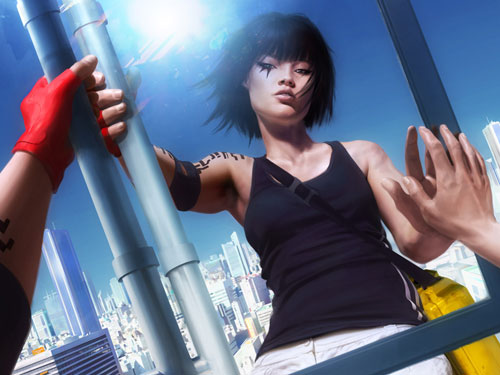
My avatar is Faith from the video game Mirror's Edge. She is a courier in her virtual world, a freerunner in our world. Her most deadly weapon is her vision, which then fuels her creativity, and ability to create paths while she traverses obstacles. I'd like to think that my most deadly weapon is also my vision, which fuels my desire for change.
Faith in action:
Counting Stars
On knees bent, I'm praying these kids don't walk the road we went/
Not because it was tough, that's the wrong reason/
But the path of the freedom fighter's called treason/
I'm fighting for change so that my son sees it/
And my daughter to understand that if she quits/
The revolution would die in that sequence/
In the meantime I produce like Seacrest/
Writing these poems to get a buzz like bees' nests/
With the people on my mind like Jesus/
Or Cassius Clay in the Congo; free us/
From preconceived notions and hatred/
Lenses, to help see through the fakeness/
Like Morpheus, been up and out of this matrix/
Came back - just to see who I could take with/
Counting stars and making new constellations/
Since zeroes and ones are still new calculations/
Not because it was tough, that's the wrong reason/
But the path of the freedom fighter's called treason/
I'm fighting for change so that my son sees it/
And my daughter to understand that if she quits/
The revolution would die in that sequence/
In the meantime I produce like Seacrest/
Writing these poems to get a buzz like bees' nests/
With the people on my mind like Jesus/
Or Cassius Clay in the Congo; free us/
From preconceived notions and hatred/
Lenses, to help see through the fakeness/
Like Morpheus, been up and out of this matrix/
Came back - just to see who I could take with/
Counting stars and making new constellations/
Since zeroes and ones are still new calculations/
Subscribe to:
Posts (Atom)